Client:
Quantity:
Size:
Application:
Quick answer: For most gravity-flow hopper and silo outlets, a slide gate is the better choice than a clamshell gate. A heavy-duty slide gate such as the Vortex® Titan Slide Gate seals more reliably, needs far less headroom (4 or 6 inches tall), weighs less, and can be serviced without removing it from the line. Clamshell gates are sometimes considered for centered discharge or for closing through large, lumpy material, but a properly configured slide gate can handle those duties as well.
The gate at the bottom of a hopper or silo is small compared to the rest of the system, but it decides a lot. It controls whether material stays contained, how much space the outlet takes up, and how often maintenance crews have to stop the line. Choosing the wrong design can mean dust escaping, blades jamming, or seals wearing out early.
Two designs come up often in gravity-flow discharge: the slide gate and the clamshell gate (also written “clam shell gate”). Both stop and start flow, but they get there in very different ways. This article explains the difference so that engineers and plant managers can choose with confidence.
How Do Slide Gates and Clamshell Gates Work?
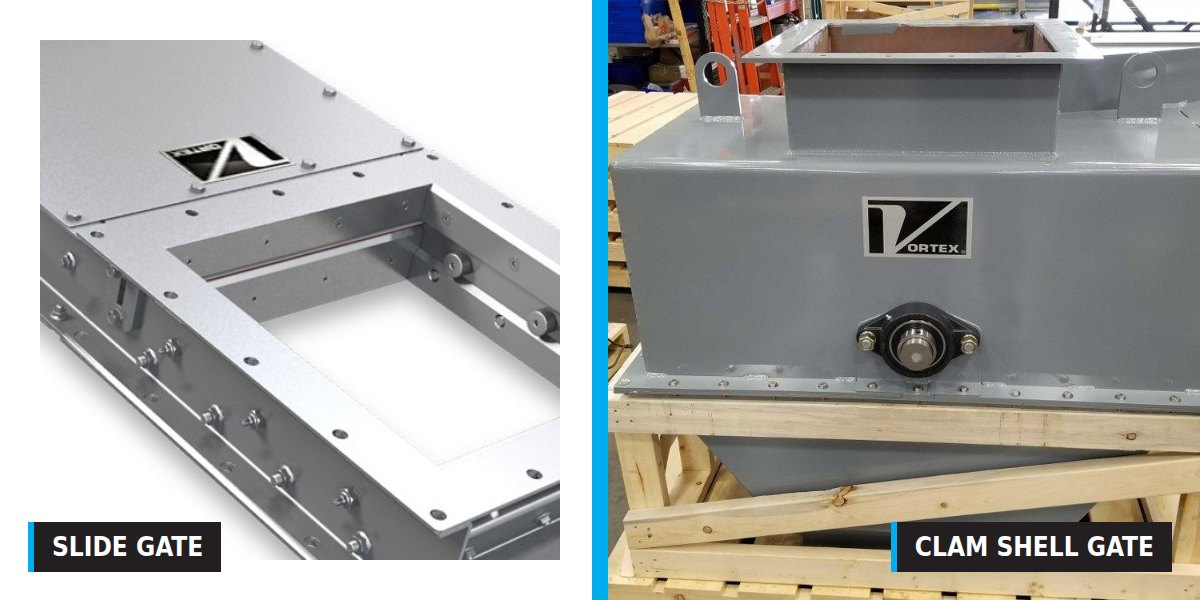
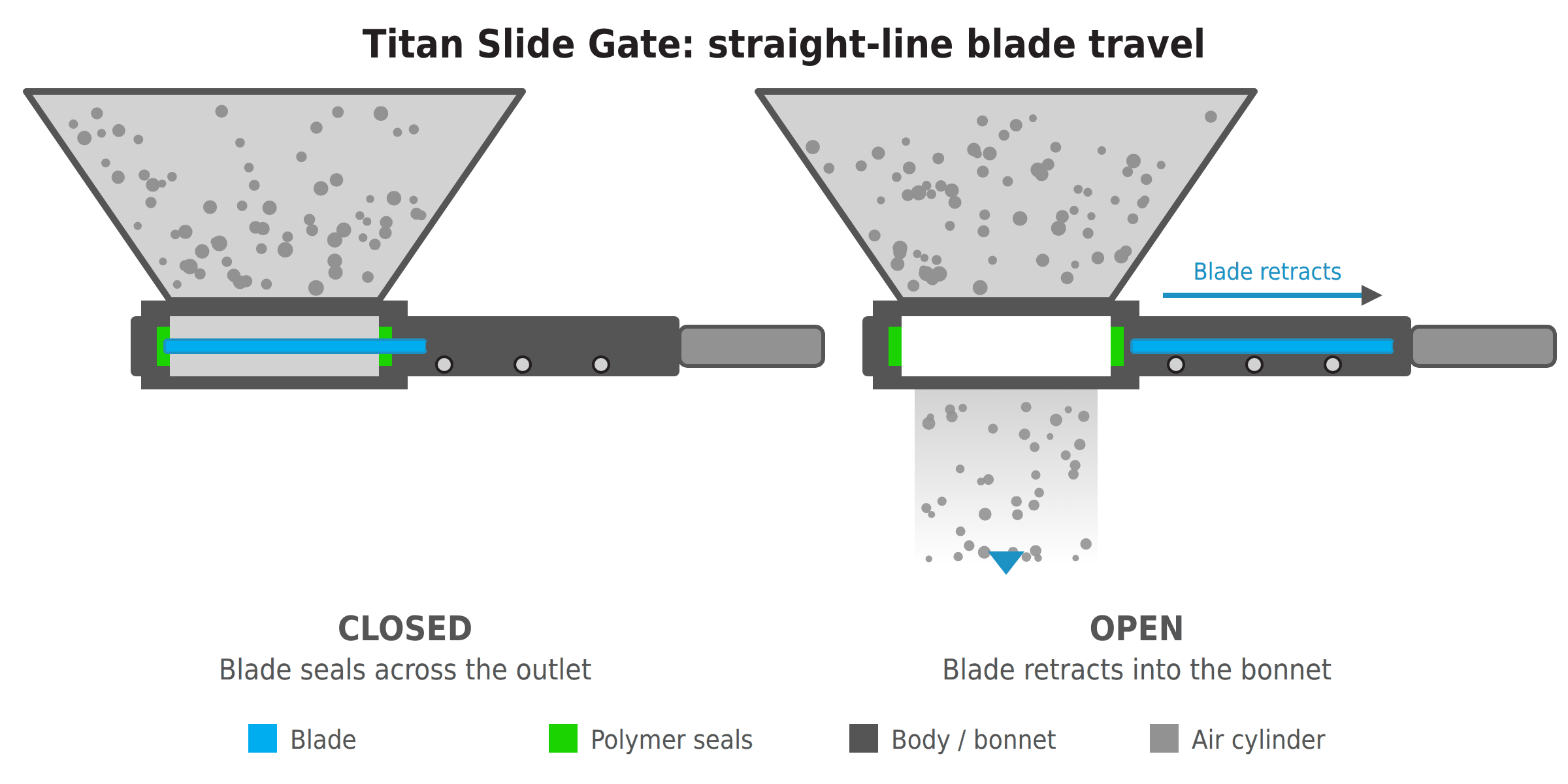
Slide gate: a straight-line blade. A slide gate pushes a flat blade across the outlet in a straight line. When it closes, the blade cuts through the column of material, and seals around the blade keep dust and fines from escaping. The Titan Slide Gate carries its blade on rollers and uses an air cylinder to open and close it. The whole assembly is usually 4 or 6 inches (100 or 150 mm) tall.
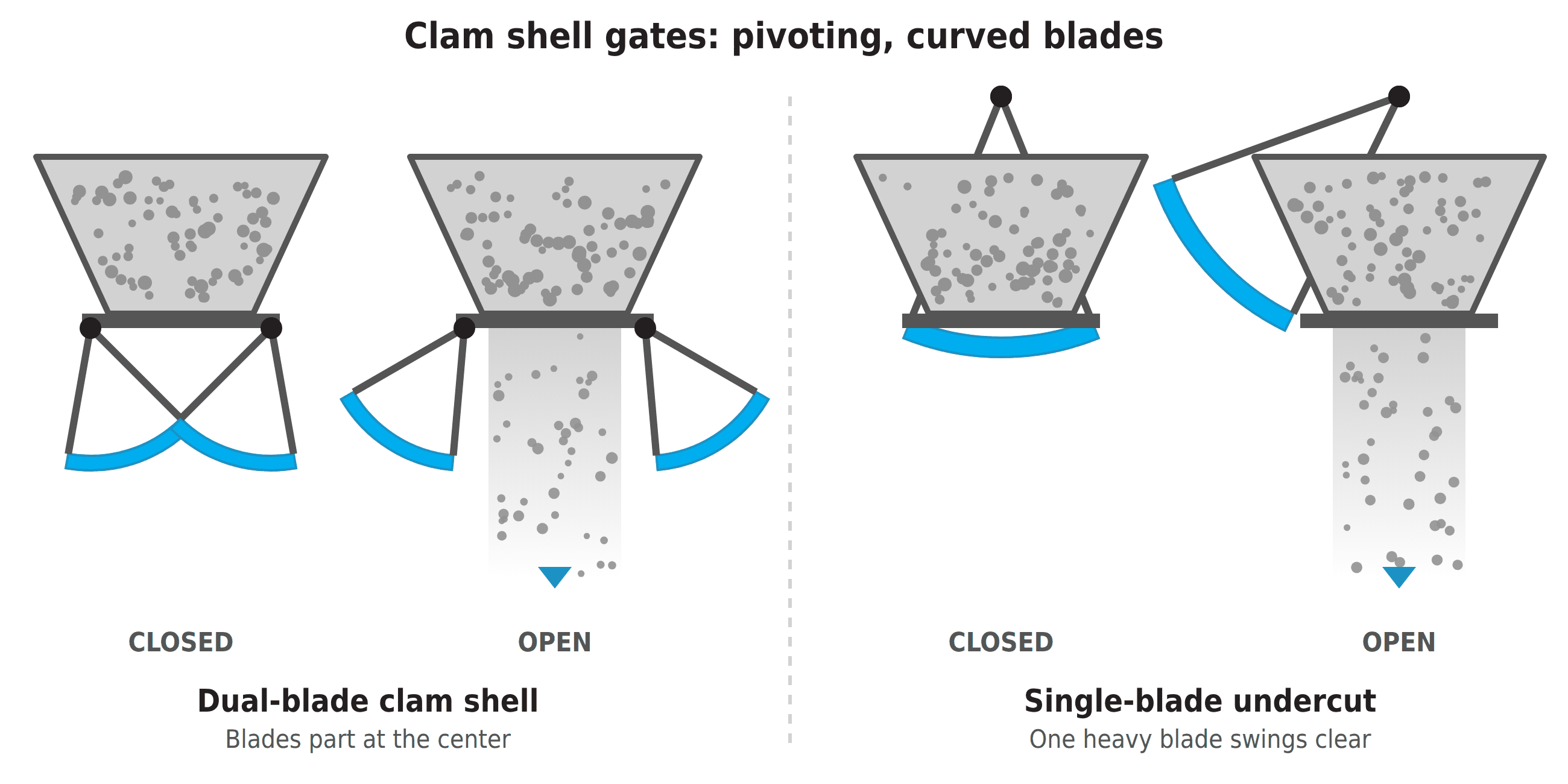
Clamshell gate: swinging blades. A clamshell gate uses one or two curved blades that pivot beneath the outlet. To open, the blades swing away from the opening. To close, they swing back together. Two versions are common:
- Dual-blade clamshell gate: a pair of blades moves in unison and parts at the centerline, so material leaves the outlet evenly.
- Single-blade undercut gate: one heavy blade swings under the opening. It is usually chosen for coarse, lumpy material, often larger than 4 inches.
What Are the Advantages of a Titan Slide Gate?
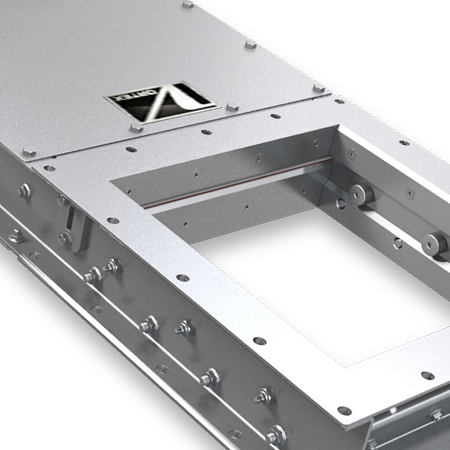
Vortex designed the Titan Slide Gate, part of the Titan Series, for tough, abrasive materials such as sand, gravel, coal, clinker, and whole grains. Several design choices make it the dependable default for hopper and silo outlets:
- Seals that adjust as they wear. Spring-loaded polymer seals press constantly against the blade and take up their own wear. The blade never rubs metal against metal, so galling is avoided.
- Protection against abrasion. Surfaces that touch the material are available in 400 BHN abrasion-resistant steel. Liners and deflectors keep the flow away from the seals.
- No packing at closure. A relief pocket at the end of the blade’s stroke gives displaced material somewhere to go. Material drops back into the stream instead of compacting against the frame.
- Cleans itself as it cycles. Closing the blade clears the side seals. Opening it keeps material from being dragged back into the housing.
- Service without removal. Worn bonnet seals push out through access ports on the side of the gate as new ones go in. The rollers adjust with a cam, so crews can restore alignment without taking the gate off the line.
- Fits tight spaces. At 4 or 6 inches tall, the gate fits under equipment where a swinging blade would not.
- Safer to work around. Moving parts are enclosed, so there are no exposed pinch points.
- Built to the application. Options include opposing-blade designs, square and rectangular openings in extreme sizes, high-temperature construction up to 400°F (204°C) continuous, stainless steel contact surfaces, fine-material sealing packages, purge-ready covers, and a return pan that sends stray material back into the process.
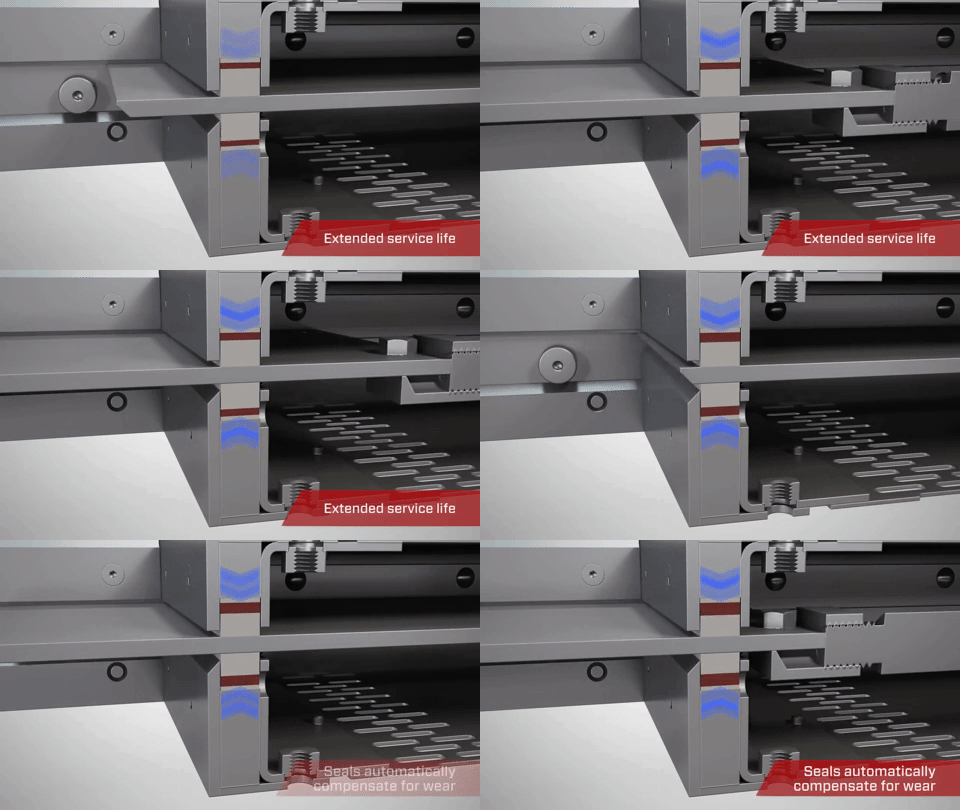
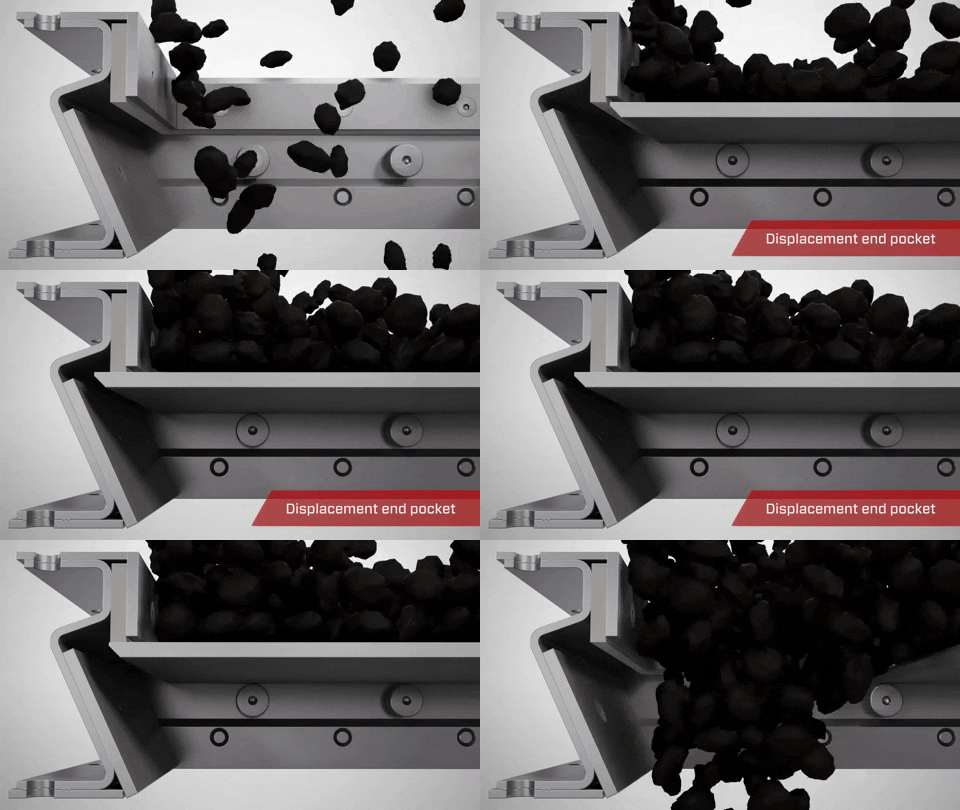
Limitations to plan for. The Titan Slide Gate is built for gravity flow, not pressurized lines. Vortex offers the Titan Pressure Valve for pneumatic conveying. Because the blade retracts from one side, a partly open gate discharges off-center. A small amount of material can also migrate into the bonnet area; the optional return pan handles this.
When Should You Consider a Clamshell Gate?
A clamshell gate is a more specialized design. It is often considered in the three situations below. A properly configured Titan Slide Gate can handle each of them as well, so it remains a strong candidate in every case.
- Even, centered discharge. In a dual-blade design, the blades part at the center, so material leaves in a balanced stream. This can matter for high-volume discharge into equipment that needs a centered feed. Vortex has also developed Titan gates with opposing blades that center the product, so a Titan can still be considered here.
- Coarse material under load. A single-blade undercut gate has wide clearances and swings closed rather than sliding. It can close through a full column of large lumps that might stall a straight-line blade.
- Metered loading. A curved blade paired with a positioner can regulate flow. Vortex has supplied a Titan Single Blade Clamshell Gate with a V-notch blade and position feedback for metering sand into trucks. Note that with a V-notch blade, flow rate is not proportional to blade stroke.

Tradeoffs to weigh.
- More height. The blades need room to swing, so a clamshell gate needs more vertical space than a slide gate.
- Harder to seal. Undercut designs in particular are hard to make dust-tight. Blade shape alone does not guarantee a better seal than a well-sealed slide gate.
- Limited flow control. Undercut gates are generally a poor choice for metering.
- More weight. Heavier blades and larger actuators add weight and structural load. A 20-inch Titan Single Blade Clamshell Gate weighs about 1,350 lb (612 kg). The heaviest standard Titan Slide Gate, at 30 inches, weighs about 560 lb (255 kg).
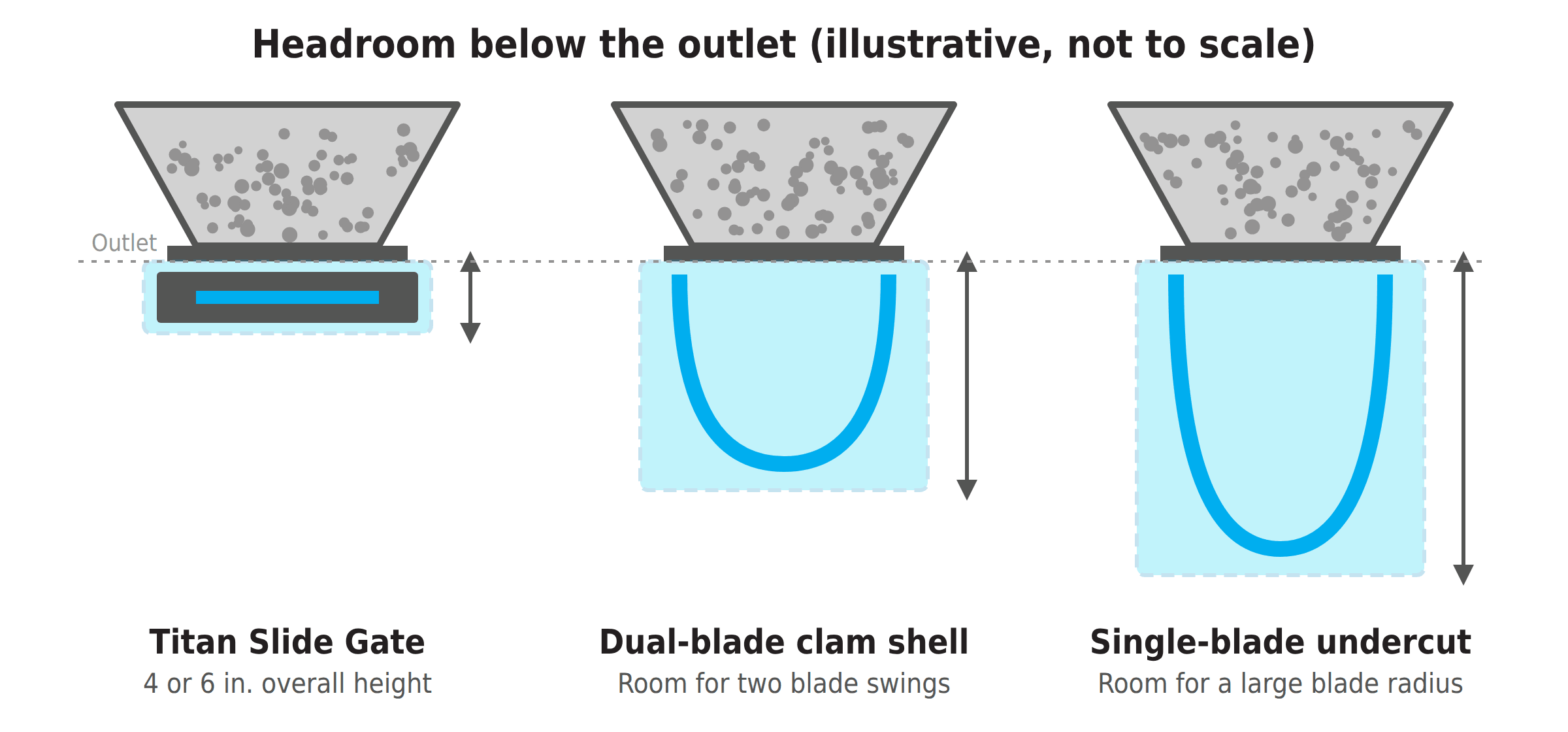
Slide Gate vs. Clamshell Gate: At a Glance
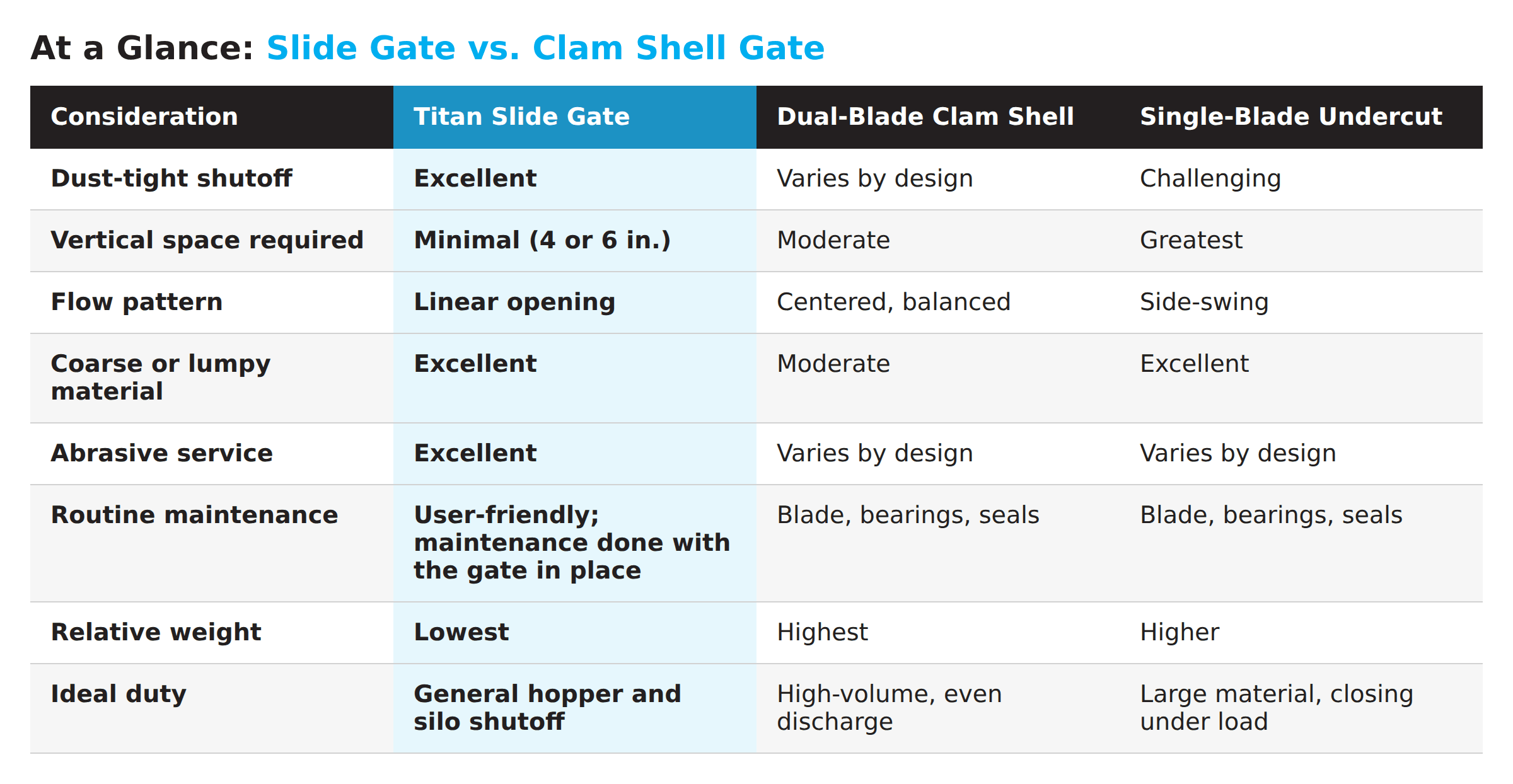
Titan Slide Gate
- Dust-tight shutoff: Excellent
- Vertical space required: Minimal (4 or 6 in.)
- Flow pattern: Linear opening
- Coarse or lumpy material: Excellent
- Abrasive service: Excellent
- Routine maintenance: User-friendly; maintenance done with the gate in place
- Relative weight: Lowest
- Ideal duty: General hopper and silo shutoff
Dual-Blade Clamshell Gate
- Dust-tight shutoff: Varies by design
- Vertical space required: Moderate
- Flow pattern: Centered, balanced
- Coarse or lumpy material: Moderate
- Abrasive service: Varies by design
- Routine maintenance: Blade, bearings, seals
- Relative weight: Highest
- Ideal duty: High-volume, even discharge
Single-Blade Undercut Gate
- Dust-tight shutoff: Challenging
- Vertical space required: Greatest
- Flow pattern: Side-swing
- Coarse or lumpy material: Excellent
- Abrasive service: Varies by design
- Routine maintenance: Blade, bearings, seals
- Relative weight: Higher
- Ideal duty: Large material, closing under load
How Do You Choose the Right Gate?
The best gate comes from the application, not habit. Answering five questions will usually point to the right design:
- What is the material? Consider particle size, abrasiveness, moisture, and temperature.
- What does the gate need to do? It may need to shut off, meter, or both.
- How much room is there? Measure the headroom available below the outlet.
- How important is containment? Dust, fines, and product loss all count.
- How will it be maintained? Think about access, downtime windows, and the skills of the crew.
For most gravity-flow shutoff duties, especially with abrasive materials in tight spaces, the Titan Slide Gate offers the best balance of sealing, durability, and serviceability. When centered discharge or closing through large material is the deciding factor, compare a clamshell design with a Titan configured for that duty, such as an opposing-blade Titan Slide Gate.
Frequently Asked Questions
Is a slide gate or a clamshell gate better for hopper discharge?
For most gravity-flow hopper and silo outlets, a slide gate is the better choice. It seals more reliably, needs less headroom, and weighs less. A clamshell gate is a specialized option for centered discharge or for closing through large, lumpy material.
Which gate needs less headroom?
A slide gate. The Titan Slide Gate is usually 4 or 6 inches (100 or 150 mm) tall. Clamshell gates need extra vertical space below the outlet for their blades to swing.
Which gate seals better?
A well-sealed slide gate. The Titan Slide Gate uses spring-loaded polymer seals that compensate for wear. Undercut clamshell gates are hard to make dust-tight, and a dual-blade clamshell’s seal depends on its specific design.
Can a slide gate handle large, lumpy material?
Yes. The Titan Slide Gate’s displacement pocket gives displaced material somewhere to go as the blade closes, so it does not pack against the frame. Single-blade undercut gates are also used for coarse material larger than about 4 inches.
Can a clamshell gate meter flow?
Some can. A curved V-notch blade paired with a positioner and position feedback can regulate flow, as in Vortex’s Titan Single Blade Clamshell Gate for truck loading. With a V-notch blade, flow rate is not proportional to blade stroke. Undercut gates are generally a poor choice for metering.
Can the Titan Slide Gate be used in pneumatic conveying?
No. The Titan Slide Gate is designed for gravity flow. For dense phase or dilute phase pneumatic conveying, Vortex offers the Titan Pressure Valve.
Vortex application specialists can review your material, process, and layout and recommend the right gate for the job. Contact Vortex to start the conversation.